Mikhail’s public confession
The Brothers KaramazovMikhail’s public confession is the delayed culmination of his struggle to acknowledge a murder he had concealed for fourteen years. Encouraged by Zossima to speak the truth, he declares his guilt before a town gathering and lays out the objects he had kept as evidence. The confession transforms a secret crime into a public act of responsibility, yet it does not bring immediate communal recognition: the listeners are horrified, and many decide that Mikhail must be deranged. His own account of the act’s consequences is different. He says that confession has brought peace to his heart, and dies a week later; afterward, the town turns against Zossima, the witness and spiritual advocate who had urged him to speak.
Causes and Preparation
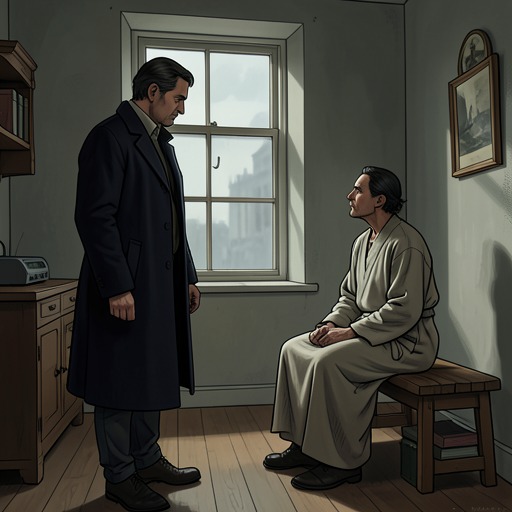
The confession follows a long inward struggle. Mikhail believes that admitting his crime could heal his soul and bring lasting peace, but that conviction fills him with terror: he does not know how he can carry it out. When he looks at Zossima, he says that he has made up his mind. Zossima responds with astonishment that so trivial an incident as their encounter could prompt such a decision, but the exchange marks a turning point: Mikhail’s private resolve now has a witness.
Zossima gives the decision practical and moral force. He tells Mikhail to go and confess, insisting that everything passes while truth remains, and urging him to trust that his children will eventually understand the nobility of his resolution. Mikhail leaves as though persuaded, but readiness does not become action at once. For more than a fortnight he returns to Zossima every evening, still preparing himself. The delay makes the eventual public disclosure an earned act of will rather than a sudden, unconsidered revelation.
Public Disclosure
Mikhail finally confesses at the annual gathering on his birthday, an occasion attended by people from across the town. After dinner he steps into the middle of the room holding a paper: a formal declaration addressed to the chief of his department, who is present. He reads the account aloud before the assembly, setting out the crime in detail. The private decision Zossima had urged him toward becomes a public declaration made before both townspeople and an official witness.
At the end of the account, Mikhail describes himself as having cut himself off from other people like a monster, says that God has visited him, and declares that he wants to suffer for his sin. He then places on the table the things he has kept for fourteen years, believing they would prove his guilt. The items include jewels belonging to the murdered woman, which he had stolen to divert suspicion; a cross and a locket taken from her neck, with a portrait of her betrothed inside; her notebook; and two letters. Their survival gives the confession a material dimension: these are not merely objects he once took, but evidence he chose to keep instead of destroying.
Reception and Consequences
The assembly is amazed and horrified, but the response does not match the certainty of Mikhail’s avowal. The listeners refuse to believe him and suppose he is deranged, even as they attend to his story with intense curiosity. In the days that follow, disbelief hardens into a shared judgment: the town agrees that Mikhail is mad. His declaration therefore has an immediate paradoxical effect. He has made the crime public, but public speech does not by itself persuade the community to accept what it hears.
For Mikhail, however, speaking changes his experience of himself. As he lies dying, he tells Zossima that God has had pity on him and is calling him, and that he knows death is near. He says that he feels joy and peace for the first time in many years, and locates the beginning of that inner peace in the moment he did what he had to do. The town’s refusal to believe him does not undo the meaning he gives to confession: in his account, truth-telling has ended his long separation from love and peace.
Mikhail’s Last Disclosure and the Aftermath
In their final meeting, Mikhail whispers to Zossima that on an earlier visit, at midnight, he had returned intending to kill him. He explains that he hated Zossima and wanted revenge, but that the Lord vanquished the devil in his heart. He adds that Zossima had never been nearer death. The disclosure enlarges the meaning of their relationship: Zossima had not merely advised a murderer from a safe distance; Mikhail had once been on the verge of making him another victim. Confession thus reveals not only the old crime but also a later threat that Mikhail had carried in secret.
A week after that meeting, Mikhail dies. The whole town follows him to the grave, and the chief priest delivers an emotional speech; people lament the illness that cut his life short. Yet the funeral does not reconcile the town to Zossima. Afterward, the townspeople are up in arms against him, and some refuse to see him. The confession’s consequences therefore divide sharply: Mikhail dies with the peace he associates with telling the truth, while Zossima bears the social cost of having urged and witnessed that disclosure.
Narrative Significance
The event sets private certainty against public disbelief. Mikhail’s declaration is supported by a detailed account and by the objects he has preserved, but the town interprets the speaker as mad rather than accepting his testimony. The confession’s force lies not in a successful public vindication, but in the moral change Mikhail says it produces in him: he moves from terror and isolation toward a willingness to suffer and a renewed capacity to love.
Its structure also turns delayed preparation into a decisive public act. First comes Mikhail’s fearful conviction that confession might heal him; then Zossima’s direct urging; then more than a fortnight of evening visits; finally, the formal declaration before the birthday assembly. The later disclosure that Mikhail once intended to kill Zossima returns the story to its most dangerous private moment, while the hostility after the funeral shows that truth can restore the confessor inwardly without restoring his community’s trust in the witness. The event is narrated by Zossima as a remembered episode, so its public climax is framed through the spiritual relationship that made confession possible.